
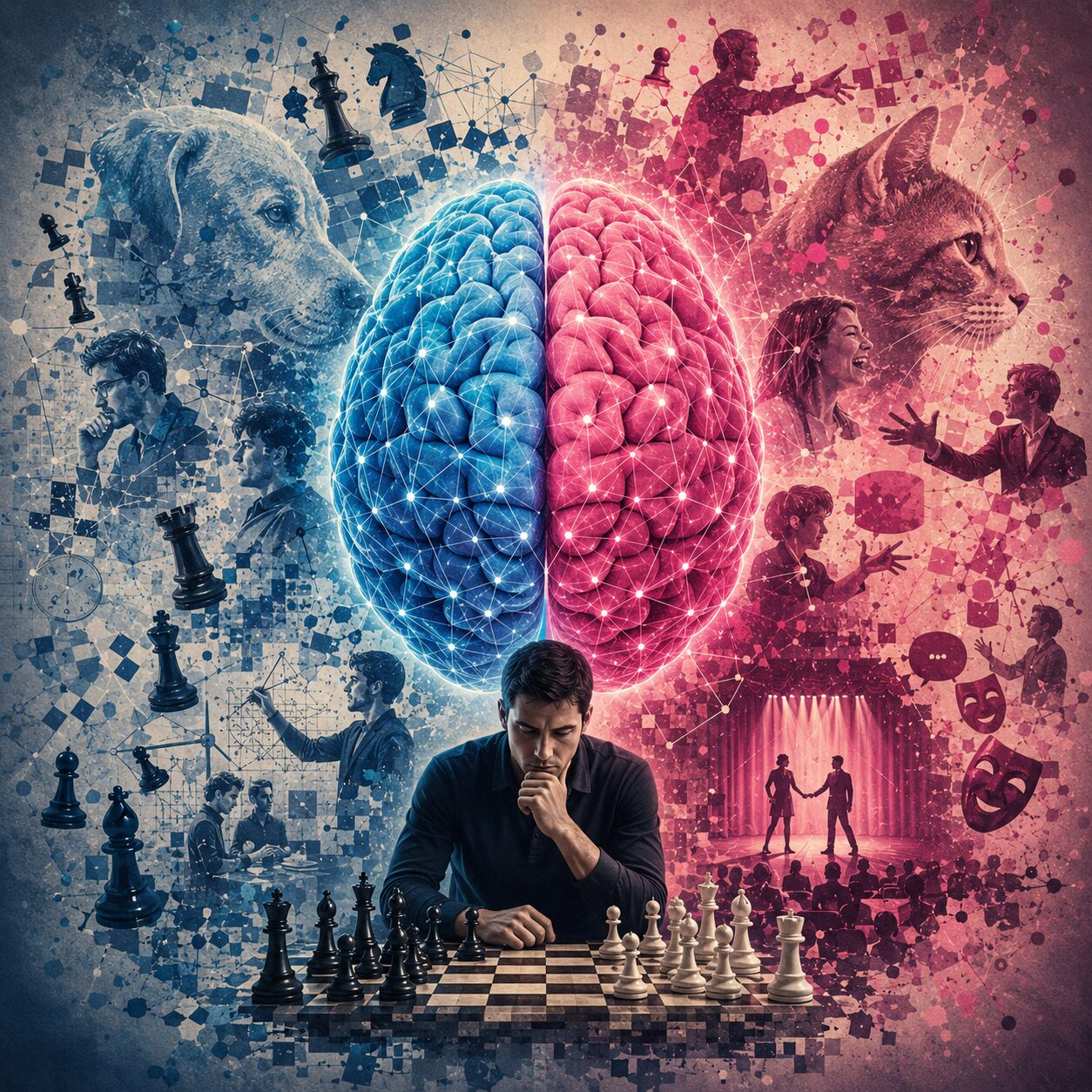
Improvisor plays Chess while dogs and cats celebrate the sneaky nod to our logo.
One of the great paradoxes of improv, is that it’s funny because the improvisors aren’t trying to be funny. That’s not the literal truth, but it’s a great maxim nonetheless – to be funny, don’t try to be funny. So, if improvisors aren’t trying to be funny, why are they so funny?
Trained improvisors are generally funnier people, whether in their personal and work lives or when playing improv. Improvisors have a naturalness to them, a more grounded confidence and self-belief in how they behave and interact with people. They’re just naturally funnier and rarely if ever by telling jokes. It can’t be because they’re not trying to be funny, otherwise most people would be just as funny, whether an improvisor or not.
Improvisors are different to non-improvisors and people in life who are habitual joke tellers. You may know that guy in real life – yes, usually a man – the one who cracks jokes all the time. Retelling old jokes, doing dad jokes, trying to make new jokes out of situations… they’re often awkward to be around. They’re not usually doing it intentionally, it’s often just a coping mechanism for social circumstances – jokes, particularly self-deprecating ones, can release tension in both them and others, making those circumstances easier to deal with. Some people may just love telling jokes to people they meet, but often compulsive joke telling is an anxiety triggered coping mechanism. There’s a whole bunch of research on how dad jokes and joke telling starts out as a social management tool and eventually becomes compulsion, but that’s for another day.
Trying not to be funny vs. Not trying to be funny
This is an important distinction. Improvisors aren’t “trying” to be funny, “trying” not to be funny, or even “trying” to be not funny. They’re not really “trying” to do anything. They’re just naturally funny and that flows through into everything they do. They don’t need to be funny all the time, but the funny is always there when appropriate.
What the above maxim really means is that trying to be funny removes some of the mechanisms that make improvisors and improv funny. The intention is to be funny, but it’s not a fully conscious process, meaning it’s not the improvisor thinking up a joke or a line of dialogue or actions that are funny, it’s just a natural part of who they are.
Processing Funny
If improvisors are naturally funny, then what is the mechanism inside them that makes them so? If we can identify that and reproduce it in other people – we can – then that’s a very useful and trainable skill.
Let’s look at how this mechanism roughly works. We’re going to get into some deeper science-y stuff though, so please bear with me.
Improvisors have trained senses and cognitive expertise – it’s like muscle memory for brain – that allows them to be funny, in life and on stage. This cognitive expertise comes about through improv practice, which is internalised and becomes a part of an improvisor’s regular behaviour.
Let’s use a different and more generally understood skill that may make this clearer: Chess. Chess players learn the game through conscious repetition. They consciously focus on the game, figuring out how to play, and on what works and what doesn’t, as is typical for learning a new skill. However, while players are consciously learning how to play, something else is happening inside them unconsciously. The brain starts to notice patterns and builds what are known as schemas, to collect information that the brain can later draw upon.
For example, if you looked at a cat or a dog, you’d know immediately whether it’s a cat or a dog, because your brain has schemas built for each. Even cats and dogs that don’t necessarily look like a cat or a dog, or are partly obscured or at a distance, can usually be identified correctly. Your brain knows, because it’s seen, heard and experienced so many variations of cats and dogs. The brain takes what your senses are currently giving it, and pattern matches the related schema, drilling down until it’s pretty confident which animal it is. (contemporary AI and LLMs work a similar way)
Games like Chess are the same. The brain starts building schemas of information around the playing of Chess. The player may be consciously learning different openings, moves and tactics, but the brain is unconsciously learning much more, such as how people interact during Chess, what their emotions and intentions are – their tells – and what higher level patterns there are on the board and the best ways to recognise and play to those patterns. This is called chunking, collecting information into chunks and then matching patterns that the brain already knows. This happens automatically without the player realising it. So, if say their opponent makes a certain move, the brain will almost immediately have a good idea of what this may mean and the opponent’s higher-level intensions. Typically, the brain will propose a few suggested meanings or understandings of the opponent and the board layout, at which point the conscious thinking kicks in and the player starts to knowingly think about response options.
When we talk about learning a new cognitive skill as learning what works and what doesn’t, this is really the brain following the above process through repetition. Learning the theory and then playing game after game after game.
Improv is the same. As we improvise, our brain starts to figure out what works and what doesn’t, and because the end goal for performance improv is being funny, what we’re doing is training our brains to be funny inside an improv scene by playing scene after scene after scene. Not all improvisors are performers of course, but the origins and thus training for improv is typically for comedic outcomes. Side coaching, theory and targeted exercises also help us make choices in the moment that work best for being funny.
Improv scenes are like real life
They are! Improv scenes are like real life! Improv is a sandboxed version of real life scenes that in the case of improv are specialised as being funny, made funny by improvisors learning how to make a social responses which are funny.
Why we laugh and are amused, and why improv is funny, are separate questions that we’ve covered elsewhere, so for now let’s just say this: improv is funny because the nature of improv is improvisors playing together without a shared plan and not expecting what the other player will do, then having to immediately respond appropriately. This unexpectedness is usually funny and comes from what’s called a collision of context. Then the other improvisor does the same and responds. Repeat. Over and over. There’s more to it, but that’s the gist of it.
Improvisors are great listeners and responders. They’re trained to work with the unexpected, to notice subtle inflections and intentions in speech, physical actions and emotions, as well as mispronunciations, homonymy and hidden meanings, and more. And they know how to draw those things out and heighten them to make a scene funnier. The same is true in life.
Don’t try to be funny
Improvising is different to making jokes. Making jokes is mostly writing a joke in your head based on your understanding of a situation. It takes time to write a joke, unless you have that specific training. Even then, it often sounds more about how witty the joke teller is than simply highlighting the humour in life that comes from just noticing it unfold – what improvisors do, in case that wasn’t clear.
When someone tries to be funny, they’re working alone and writing the funny in their head. When improvisors try to be funny, they’re also working alone and writing the funny in their head, but additionally they’re detaching themselves from the scene while they come up with their joke, and they’re turning off the skills that makes improv workable and funny: listening, noticing and reacting right here right now and in the moment.
When we say “Don’t try to be funny”, we don’t mean to actively try and not be funny. Funny comes from enacting the trained skills of improvisation, which for improvisors is a natural part of their default behaviour. When they try to be funny, that’s not improvisation and so then they’re just like everyone else and writing jokes in their head.
Audiences notice when someone is trying to be funny in improv, it stands out initially as funny, before improv breaks and the scene collapses – suffice it to say, it’s then no longer funny. This is similar to life but to a slightly lesser degree. Although obviously life doesn’t break so much. Remember the joke guy we talked about above? Yep, that’s probably him.
Regardless of training, isn’t this behaviour still “trying to be funny”?
Not really, because we’re no longer trying, we’re doing.
When you’re learning to ride a bike or play a ball sport, in the early days you talk about how you’re learning to or trying to learn how to ride a bike or hit a ball. Then as you get better, it becomes part physical muscle memory and part cognitive expertise, and then you start saying that you ride a bike or you play a sport. Once you’ve learned how to ride a bike, you’re no longer trying, you’re doing.
Like most things, learned skills become a part of your natural behaviour. Improv and being funny is no different.
Why are improvisors funny in life and on stage? Because they’ve changed their behaviour to naturally be so, and they did that through learning improv.